
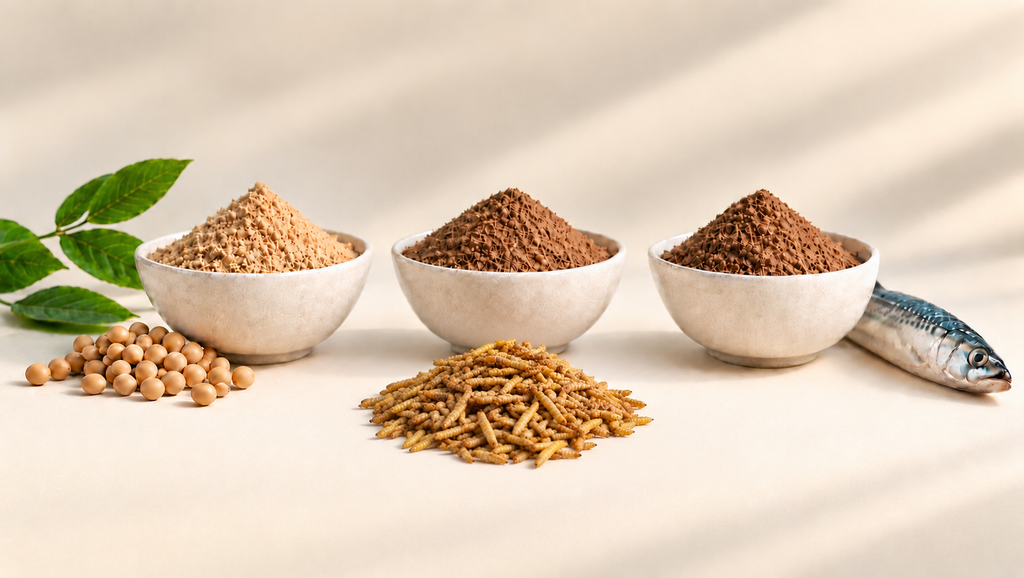
Every aquafeed formulator eventually faces the same question: Does switching part of a formulation to an alternative protein actually hold up against the ingredient it is replacing? For BSFL meal, that question keeps coming back to two entrenched benchmarks: fishmeal and soybean meal. This article walks through what the research and nutritional data actually show when BSFL meal vs. fishmeal and BSFL meal vs. soybean meal comparisons are put side by side, without overstating the case either way.
At Jital Solutions, we work with formulators who are evaluating this switch for cost, sustainability, supply security, or often all three at once. Here’s how the comparison breaks down.
Why This Comparison Matters Right Now
Fishmeal supply is tied to wild-catch fisheries, which makes it vulnerable to quota changes, El Niño-driven catch fluctuations, and long-term sustainability pressure. Fishmeal price volatility has become a recurring planning problem for feed manufacturers, pushing many toward alternative-protein aquafeed research as a hedge rather than a purely ideological choice.
Soybean meal, the other major benchmark, is more price-stable but comes with its own formulation limitations, notably, anti-nutritional factors and a less complete amino acid profile for carnivorous species. BSFL meal sits in an interesting middle position, and the research reflects that nuance.
BSFL Meal vs. Fishmeal: Nutritional Comparison
Crude Protein and Amino Acid Profile
Fishmeal has long been the gold standard for crude protein content and a complete essential amino acid profile, particularly for carnivorous fish and shrimp. BSFL meal’s crude protein content is generally in a comparable range, and its amino acid indexwhile not identical to fishmealincludes meaningful levels of lysine and methionine that reduce, though do not always eliminate, the need for synthetic amino acid supplementation when used as a partial replacement.
Lipid Profile
Fishmeal’s lipid profile is rich in long-chain omega-3 fatty acids (EPA/DHA), which BSFL meal does not naturally replicate at comparable levels. This is one of the more consistent findings in fishmeal replacement-ratio research: BSFL meal performs well on protein and several amino acids, but formulations still often need a supplementary lipid source to fully match fishmeal’s omega-3 contribution, especially for marine species with high EPA/DHA requirements.
Replacement Rate Research
Across published feeding trials, BSFL meal optimal inclusion-rate findings vary by species and life stage, but partial replacement commonly in ranges well short of 100%tends to preserve growth performance and feed conversion outcomes most reliably. Full or near-full fishmeal replacement studies show more variable results depending on how well the formulation compensates for lipid and micronutrient gaps.
BSFL Meal vs. Soybean Meal: A Different Kind of Comparison
Soybean meal is a plant-based protein with a very different limiting profile than fishmeal. It is generally lower in certain essential amino acids (notably methionine) relative to fishmeal, and it carries anti-nutritional factors that can affect palatability and digestibility, particularly in carnivorous species. BSFL meal vs. soybean meal protein-content comparisons generally favor BSFL meal on amino acid completeness and palatability, while soybean meal typically holds a cost advantage due to its scale of global production.
For formulators blending multiple protein sources, BSFL meal is increasingly used as a complementary ingredient that helps offset some of soybean meal’s amino acid gaps, rather than as a straight one-for-one substitute.
Sustainability Metrics: Where BSFL Meal Distinguishes Itself
This is where the comparison becomes less about matching fishmeal nutritionally and more about the broader ingredient case. BSFL production converts organic waste streams into protein, which fundamentally changes the sustainability metrics involved: land use, water use, and carbon footprint per unit of protein produced are generally more favorable for BSFL meal than for either wild-caught fishmeal or intensively farmed soybean.
Life cycle assessment (LCA) studies on black soldier fly production consistently point to lower environmental impact per kilogram of protein compared to conventional animal protein sources, even where nutritional parity is not a perfect 1:1 match.
For sourcing directors and formulators under pressure to hit sustainability targets alongside performance targets, this is often the deciding factor once a BSFL meal has cleared the nutritional bar for a given formulation.
Cost-Performance: The Practical Bottom Line
Ingredient cost-benefit analysis rarely comes down to price per ton alone. Fishmeal’s price volatility makes long-term feed cost planning difficult, while BSFL meal production being independent of ocean harvests and tied instead to controlled-input rearing offers more predictable, plannable pricing over time.
When formulators run a full cost-benefit view that includes price stability, waste-stream sourcing costs, and reduced dependency risk, BSFL meal often performs better than a straight per-ton price comparison would suggest.
What the Research Doesn’t Yet Fully Settle
It’s worth being direct about where the evidence is still developing:
• Full fishmeal replacement (100%) remains inconsistent across species in published research; partial replacement has the strongest evidentiary support.
• Species-specific amino acid gaps, particularly for high-EPA/DHA-requirement marine species, still often require supplementation alongside BSFL meal.
• Long-term, large-scale commercial trial data is still growing relative to the volume of controlled laboratory studies.
Formulators evaluating BSFL meal should treat these as active areas requiring their own species- and system-specific validation rather than assuming universal results from published literature.
What to Look for When Comparing Suppliers
• BSFL meal vs. fishmeal specification comparisonget side-by-side crude protein, amino acid, and lipid data, not just headline protein percentage.
• Lab reports and COAs for batch consistency.
• Sustainability documentation, including sourcing and production methodology.
• Technical support for determining an appropriate replacement ratio for your specific formulation and species.
Frequently Asked Questions
Is a BSFL meal better than fishmeal?
It depends on the criteria. BSFL meal compares favorably on several amino acids and offers stronger sustainability and price-stability metrics, but fishmeal still generally leads on long-chain omega-3 fatty acid content. Most current research supports BSFL meal as a strong partial replacement rather than a universally “better” ingredient across every metric.
What does research say about insect meal in aquafeed?
Published feeding trials generally show that BSFL meal, at appropriate inclusion rates, supports growth performance and feed conversion comparable to conventional protein sources, with the strongest evidence for partial rather than full fishmeal replacement.
Can a BSFL meal fully replace fishmeal?
Full-replacement studies show more variable results than partial-replacement studies, largely due to gaps in long-chain omega-3 content and species-specific amino acid requirements. Most commercial formulations currently use BSFL meal as a partial substitute.
How does BSFL meal compare nutritionally to soybean meal?
BSFL meal generally has a more complete essential amino acid profile than soybean meal, particularly for methionine, and does not carry the same anti-nutritional factor concerns, though soybean meal typically has a cost advantage due to production scale.
Get in Touch
Jital Solutions supplies BSFL meal to aquafeed formulators evaluating a shift from fishmeal or soybean meal, backed by specification sheets, lab reports, and technical guidance on appropriate replacement ratios for your species and system. Reach out to request comparison data or a bulk quotation.